Sunday, October 21, 2007

I can’t believe Dembski chose Word Mutagenation!!


Take a look at William Dembski’s latest draft manuscript, Active Information in Evolutionary Search The Information Cost of No Free Lunch.

Dembski: Proponents of intelligent design have argued that the NFLT shows that Darwinian evolution cannot generate the information required for biological complexity from scratch but instead merely reshuffles existing information.

The NFLT (No Free Lunch Theorem, Wolpert and Macready 1997) doesn’t suggest that Darwinian Evolution can't generate information in the sense of searching a fitness landscape. Rather, it merely states that it may or may not be the best conceivable algorithm for finding fitness.

Dembski: Making such assumptions about underlying search structures is not only common but also vital to the success of optimizing searchers (...).

Such assumptions, however, are useless when searching to find a sequence of, say, 7 letters from a 26-letter alphabet to form a word that will pass successfully through a spell checker… With no metric to determine nearness, the search landscape for such searches is binary—either success or failure. There are no sloped hills to climb.

I can’t believe Dembski chose Word Mutagenation!! He couldn't be more wrong.

It’s been three years since I published Word Mutagenation on the web, the result of a year-long thread on the newsgroup Talk Origins with Intelligent Design advocate, Sean Pitman. I suppose it’s time to dust off the old Letter Mutator and take another look.

Turns out we don’t have to make any assumptions about the search space of words. For instance, we could start with the single-letter word “O”, a replicating population representing a veritable Pond of O’s flowing down to the Sea of Beneficence.

In the beginning was the Word.

We then mutate words in our Sea. We might change a random letter, add a random letter, delete a random letter, or randomly recombine words in the Sea. Something like this:

o
i
bi
be
or
to

no
not

If a mutant sequence is not a valid word, that is, if it fails the spell-checker rule that Dembski established above, then it is ruthlessly eliminated with no issue. If it is a valid word, it enters the population as a new strain. (We might optionally limit our Pond of Words to just a certain number of the longest words.) So, what do we expect?

Quick calculation:
10-letter words in dictionary ~10^4
10-letter sequences possible ~10^14
Ratio of valid 10-letter words to possible sequences ~10^10

A random search would take ~10^10 or several billion mutations. An evolutionary search algorithm takes only ~10^5 mutations or about a hundred thousand times faster—consistently. There is nothing about the structure of words in Word Mutagenation. It works in the simplest of fashions; random mutation and spell-check, over and over again.

The structure is found in the words themselves. Turns out that language itself has evolved and evidence of that history is found in the words we use.

The fault, dear Brutus, is not in our stars,
But in ourselves.

Labels: ,

Wednesday, June 28, 2006

Uncommon Dissent

An interesting event occurred at William Dembski's blog, Uncommon Descent. I was banned! (Dembski is supposedly one of the leading Intelligent Design "theoreticians".)

The moderator of Uncommon Descent is DaveScot (who claims a genius IQ). He made a series of misstatements (see comments). He apparently highly resents being corrected. He likes to ridicule people who disagree with him — no matter how valid and reasonable their criticism might be. (I try to abide by these rules when commenting on blogs.)

I checked the moderation policy, and yes indeed, "ID-critics" are not welcome. Apparently, Intelligent Design doesn't hold up well under close examination. DaveScot would even inject pointed questions into my comments, then 'neglect' to post the response.

I found the situation rather amusing, but it wasn't of any major concern because most of the posts on Uncommon Descent lack substance and are unlikely to convince any general readers, and because DaveScot's behavior clearly undermined whatever influence he might have had.

Or in the words of DaveScot, "What’s the matter [church burnin’ ebola] boys, cat got your tongues?" I suppose I didn't measure up to the level of discourse required.

The Panda's Thumb is the virtual pub of the University of Ediacara.Addendum: Apparently DaveScot has been banned from Panda's Thumb for threatening to hack the site and for using another person's nym. That might explain his bitterness.

Labels:

Wednesday, May 31, 2006

La Nostra Bambina

Louvre.fr
But Mona Lisa must have had the highway blues.You can tell by the way she smiles. — Dylan

Louvre.fr

Mona Lisa, La Gioconda, La Nostra Bambina giocando Nascondere-e-Cercare, in Bits:
http://www.zachriel.com/monalisa/

Labels: ,

Saturday, February 25, 2006

Come home, little Physarum!

My once upon a time best friendI used to have a pet slime mold, but it ran away.

I still remember each morning being greeted by my pet slime mold (well, not really greeted because it didn't have a mouth). I can still see its visage (well, not really visage, but sometimes if you squinted you could make out the image of the Madonna, or other times it looked more like a cheese sandwich). Sunflower GardenIn the evenings, it would be gone, but it would always be there the next morning, playing hide-and-seek among the sunflowers, the dawn light glistening off my slimy friend's velvety skin (well, not really skin, but more like congealed ooze).

I had sought my little plasmoidal friend's advice on the Phrasenator Project—and it was always willing to listen (well, I'm sure it would have listened if it had ears). I should have given it credit for helping with the software: the code did sort of resemble the amorphous structure of a slime mold.

I considered a leash, but thought it would be wrong to chain a wild slime mold (plus there was the issue of not having a neck). In any case, I miss our frolicking in the flowers (well, not really frolicking), and our long leisurely walks (well, it didn't really walk because it didn't have legs, but it did move, albeit very very slowly).

A new friend in the garden!If you love something, let it go. Set it free. If it comes back, it is yours. If it doesn't, it never was.

Alas! Farewell, my little Myxomycetes.

Labels:

Saturday, December 17, 2005

Random Walkers

Ministry of Silly Walks
Mr Pudey: Well sir, I have a silly walk and I'd like to obtain a Government grant to help me develop it.

Just another silly bit of Jovian computer code... RANDOM WALKERS is an iterative search algorithm known as the "drunkard's walk". Not a particularly efficient method, but claimed to be relevant for a Talk.Origins discussion concerning biological evolution and neutral drift.

RANDOM WALKS

Labels: ,

Tuesday, November 01, 2005

Humans are animals

Dissection of Human FemaleLet's not quibble over details. Humans are clearly animals.

Protists Which Move and Feed Using PseudopodiaNote that humans are members of the Animal Kingdom, that is, like sponges, they ingest food for energy and for protein, the building blocks of their structure. In addition, they have an alimentary canal, where food passes from one end, the mouth, to the other, just like earthworms. They are also vertebrates, that is, like fish, they have a bony spine Fossils illuminate fish evolution which protects a nerve cord, and a head at one end which has an array of sense organs. They have four limbs like frogs and iguanas. They are mammals, so like mice, they nurse their young with a proteinous secretion produced by special glands. They are placentals, and bear their young live.

All modern mammals evolved from a group of reptiles that lived more than 200 million years ago. Indeed, humans ARE animals, specifically mammals. They ingest, digest, defecate, copulate, nurse. They love and they hate. They are prideful and compassionate. They have hair, eyes, three ear-bones and two gonads. They are composed of blood and bones, livers and brains, synapses and cell-membranes. These are all features of life found in many other animals.

Leonardo Da Vinci

Labels:

Monday, September 12, 2005

Pharyngula

For anything on the embryonic development of Zebrafish, Danio rerio, Pharyngula is the place to be!

For more evidence on the Theory of Evolution, check out Deep homologies in the pharyngeal arches at Pharyngula.


What the heck is a pharyngula? "a particular stage in the development of the vertebrate embryo ... Specific cells in the pharyngeal arches will form gills or glands, depending on the species of vertebrate.an evolutionarily conserved period when vertebrate embryos of all species are most similar to one another, and has a repeated series of pharyngeal arches. These are characteristic chordate tissues that form a 'basket' of cartilage and associated tissues in the throat; they contribute to jaws and facial structures, ear bones, gill arches, etc."

Human gland evolved from gills.

These images really tell the story. The embronic cells which become gills in fish, become glands in humans, both depending on the gene Gcm-2.


Proceedings of the National Academy of Sciences, December 2004


Okabe and Graham tell all in the Proceedings of the National Academy of Sciences.

Next: The Jawbone of an Ass....

Labels:

Monday, September 05, 2005

Talk.Origins

I have had a number of discussions concerning the creation/evolution controversy — often on blogs. However, most blogs do not offer the bandwidth or the multi-threading necessary for detailed scientific discussions. Due to these limitations, I often refer people to the Usenet newsgroup Talk.Origins *.

Talk.Origins Archives"Talk.Origins * is a Usenet newsgroup devoted to the discussion and debate of biological and physical origins. Most discussions in the newsgroup center on the creation/evolution controversy, but other topics of discussion include the origin of life, geology, biology, catastrophism, cosmology and theology."

The Talk.Origins Archives offers a variety of articles and essays providing mainstream scientific answers to many frequently asked questions (FAQ). The Talk.Origins Archives have won numerous awards and mentions.

( * Note: If you do not have a newsgroup reader, you can access Talk.Origins through Google Groups. Or, many email programs can be configured for newsgroup.)

The Panda's Thumb is the virtual pub of the University of Ediacara.

Labels:

Sunday, September 04, 2005

Forearmed with knowledge

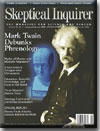
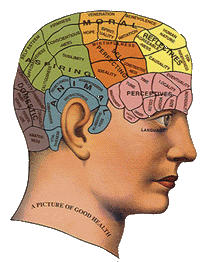
Snaring the Fowler: Mark Twain Debunks PhrenologyIn the 19th Century, a new pseudo-science emerged to join the likes of alchemy and astrology. Called Phrenology, it claimed to be able to judge the aptitudes and characteristics of people by noting the bumps on their head, which presumably would give clues to the structure of the brain within the skull. The most important of these Phrenologists was a man named Fowler.

From the Skeptical Inquirer:

Britannica: Phrenology enjoyed great popular appeal well into the 20th century but was wholly discredited by scientific research.Forearmed with a knowledge both of phrenology and the tricks of con artists, the famous author Mark Twain performed a simple single-blind reliability test. In 1872 or 1873, he visited Fowler's London office and paid for a reading using a pseudonym.

"he found a cavity, in one place; a cavity where a bump would have been in anyone else's skull. That cavity, he said was all alone, all by itself, occupying a solitude, and had no opposing bump, however slight in elevation, to modify and ameliorate its perfect completeness and isolation. He startled me by saying that that cavity represented the total absence of the sense of humor!"

Twain returned to Fowler three months later and sat for a second reading, this time identifying himself. On this occasion, the reading differed greatly: "Once more he made a striking discovery-the cavity was gone, and in its place was a Mount Everest-figuratively speaking-31,000 feet high, the loftiest bump of humor he had ever encountered in his life-long experience!"


Google Scholar: Stand on the shoulders of giants.Twain has been cited for his single-blind reliability test in the scientific literature. Here are a few other cites to Twain's scientific results from Google Scholar.

National Library of MedicineIt is the ability to make reliable predictions that is the hallmark of science. I would also note that you don't have to have a PhD to practice the scientific method. Twain was doing science, and his only qualification was his ability to see the con.

Labels: ,

Tuesday, August 30, 2005

Project Steve

National Center for Science Education
Project Steve "is a tongue-in-cheek parody of a long-standing creationist tradition of amassing lists of 'scientists who doubt evolution' or 'scientists who dissent from Darwinism'… Project Steve mocks this practice with a bit of humor, and because 'Steves' are only about 1% of scientists, it incidentally makes the point that tens of thousands of scientists support evolution. And it honors the late Stephen Jay Gould, NCSE supporter and friend."

Testimonials:
Not only Steves, but also Stephens, Stevens, Stephanies, Stefans, Etiennes and Estebans!I must have had the worst love life in the whole field of leech systematics, but now that I'm an NCSE Steve my social life has really taken off! — Steve

Before I became an NCSE Steve, opportunities just never seemed to come my way. But now my department chair holds the door open for me, and brings me coffee! — Stephanie

Steve here. I have been waiting my entire scientific career for just such an opportunity...a chance to STAND OUT...a chance to SHINE...a chance to SHAMELESSLY CAPITALIZE WORDS THROUGHOUT MY SENTENCES!!!...AND TO USE EXCLAMATION MARKS!!!...WITHOUT REASON!!!! — Steve

The Lucasian Professor of Mathematics at Cambridge University, Stephen W. HawkingStephen Hawking is #300 on the Steve list. I'm waiting for the list of Zachriels who support science education. I'll definitely sign up for that one!

Labels:

Monday, August 29, 2005

Martian Dust Devils

Martian dust devils

Spirit and Opportunity on Mars

You can find more images of Martian dust devils on NASA's Rover Mission website.


"Ah, Martian summer! Finally, the days are long, just like on dear old Earth. And daytime highs rocket all the way up to a balmy 20°C (68°F) from the summer nighttime low of -90°C (-130°F), meaning you and your fellow astronauts can warm up your machinery earlier to get a good start on mining operations."

— from Science@NASA


Labels:

Saturday, August 20, 2005

Evolution Defined

The Tree of Life, a.k.a. the nested hierarchy of common descent "Nothing in Biology Makes Sense Except in the Light of Evolution." — Theodosius Dobzhansky

Darwin's original Theory of Evolution has been constantly refined in the light of new knowledge. That's how science works! However, the basic concepts of variation, natural selection and common descent are very strongly explanative concerning the millions of data points across multiple fields of study, including biology, paleontology, chemistry, and even geology.

Archaeopteryx retained many dinosaurian characters which are not found in modern birds, whilst having certain characters found in birds but not in dinosaurs.
---
Evolution is the observed change in allele frequencies in populations over time. The Theory of Evolution explains the mechanisms of evolution, including mutation, variation, natural selection, sexual selection, genetic drift, speciation, hybridization, contingency, common descent, etc. The primary areas of evidence are as follows:


* The nested hierarchy of extant life.
* The nested hierarchy in time of extinct life.
* The nested hierarchy of embryonic development.
* The nested hierarchy of biochemistry.
* The nested hierarchy of biogeography.
* The discovery that heredity is chemistry (Watson & Crick, 1953).
* Observation of genetic mutation.
* Observation of natural and artificial selection and their effects.
* Observation of genetic drift and fixation.
* Observation of speciation in the wild and in the lab.
* Observation of hybridization in the wild and in the lab.
* The recently discovered nested hierarchy of genomes (including endogenous retroviruses and pseudo-genes).
* Direct manipulation of the genomes.


The National Academy of Sciences (NAS) is an honorific society of distinguished scholars engaged in scientific research.
NATIONAL ACADEMY of SCIENCES: "The theory of evolution has become the central unifying concept of biology and is a critical component of many related scientific disciplines. In contrast, the claims of creation science lack empirical support and cannot be meaningfully tested."

Labels:

Monday, August 15, 2005

Principle of Superposition

Geological Map of England and Wales and Part of Scotland From geology, the Principle of Superposition, briefly, that a stratum (a sedimentary rock layer in a tectonically undisturbed sequence) is younger than the one beneath it and older than the one above it. This allows the relative ordering by time of fossils found in the strata.


  • Lucy is a fossil specimen of Australopithecus afarensis.New biological forms appear at different times in the fossil record.
  • New forms are preceded by similar forms.
  • New features are modifications of features existing in a preceding form.
This creates a nested hierarchy, a diversification of forms from common ancestors.

From this, we can make predictions about intermediate forms. For instance, Darwin predicted that there would be found fossils of organisms that had shared features of both humans and other apes. Many species and examples of such intermediate forms have been found, and have been found in the appropriate strata, e.g. Australopithecus afarensis has been found in strata dated at about 3¼ million years.

Geological strata containing an  evolutionary sequence of fossilsBut, even then, the fossil evidence is not the best evidence in support of the Theory of Evolution. The best evidence is in recently discovered genetic data.

Labels:

Wednesday, August 10, 2005

The Scientific Method

Albert EinsteinThe scientific method: hypothesis, prediction, observation, validation, repeat. The scientific method is a recursive system of matching theory with observation.

A hypothesis is a tentatively held conjecture for the purposes of developing predictions of empirical observations. Workable scientific hypotheses have historically come from almost any source, including deep-thought or vast experience in a field of study, but also from a hunch, a dream (Kekulé), serendipity, an inspiration, from fanciful thought-experiments (Einstein), a lucky guess, or even while playing cards (Mendeleev). However any such scientific hypothesis must be reasonably consistent with known observations and make scientific predictions of future observations. Most hypotheses are naturally derived as extensions of existing theories.

In other words, the hypothesis is just one step in the scientific method. It must then be confirmed through observation. The more successful the hypothesis is at predicting various observations, the more confident we are in its validity. But all scientific findings are considered tentative and subject to revision upon new information.

——
Star Factory as imaged by the Hubble Telescope
Most of science is composed of non-intuitive conclusions. If the facts were obvious or just common sense, we wouldn't need the scientific method to make these determinations. The Earth is billions of years old. The Solar System is vast, but just a speck in the Milky Way Galaxy, which itself is just a speck in the Cosmos. Most "interesting" atoms were forged in the bellies of huge exploding stars called supernova.

The Abjuration of Galileo Galilei
Eppur si muove!


Galileo's telescope
Many aspects of science can be easily confirmed. We can repeat the experiments of Galileo, build a telescope and see the phases of Venus. Like Faraday, we can make an electric motor to demonstrate the relationship between electricity and magnetism. Geological Map of Great BritainWe can make a microscope, just as Leeuwenhoek did, and rediscover tiny animalcules swimming in a single drop of water. We can see the spectrum of the Sun by using a prism, just as Newton did. Or we can take a hike, examine the geologic column, and verify the maps of geologists, such as those of William Smith — perhaps even finding a few common fossils.

Leeuwenhoek: I then most always saw, with great wonder, that in the said matter there were many very little living animalcules, very prettily a-moving.It is the repeatability of scientific observations that allows us to have confidence in our conclusions.

Labels:

Saturday, June 25, 2005

The Poetry of Genetic Algorithms

Mutagenation, Zachriel's Word Mutation Experiment
Mutagenation
Zachriel's Word Mutation Experiment


Zachriel's Phrase Evolution Experiment
Phrasenation
Zachriel's Phrase Evolution Experiment

Labels: ,

Nested Hierarchy

Not just a similarity, but a family resemblance!
Nested Hierarchy


Not just a similarity,
but a family resemblance!

Labels: ,